Designing for Daggerheart Workshop Key Takeaways

I had the opportunity to attend the "Designing for Daggerheart: Homebrew and Beyond" workshop at Gen Con this year, and it was such a valuable experience that I wanted to share my key takeaways with the community.
This workshop was led by Daggerheart designers Rowan Hall, Spenser Starke, and Rob Hebert. It ran for two hours. The first half was the designers presenting on core principles, and what they wish people knew about designing for Daggerheart. In the second half we got into small groups to design an Environment stat block. We rolled on random tables to prompt us, and then we did feedback and Q&A with the devs on what we had made.
At the start of the workshop we discussed how there's a sliding scale between homebrewing for your specific table, homebrewing something and throwing it up online somewhere, publishing something as a third party publisher, and then publishing something "official" as say a contractor for the first party publisher. All of them have pros and cons. When you're homebrewing for your table you can pretty much do whatever you want and hyper tailor your designs to the table. When you're creating official content it has to be a lot more general and heavily tested.
They also quickly surveyed the group of about 40 attendees. The results were:
- Everyone identified as a GM
- About a dozen or so people were interested in publishing something someday, even if that just meant throwing it up online for free.
- But only me, and two other people, were interested in publishing say "a book" or another large official project some day
I would have thought that more people attending the "Designing for Daggerheart" panel would be well, interested in designing. But I hope everyone got a lot of value out of it regardless!
Now, I want to go through the tips I took away from the workshop. I took a lot of notes during the experience, but nothing here should be taken as direct quotes. The takeaways and assumptions here are my own understanding and summaries of what was discussed.
At the end I have also included my finished version of the Environment stat block we started to create during the workshop.
Core Principles
The number one principle we discussed throughout the workshop was Fiction First. This is a term I see bandied about online a lot, with many varying definitions, but in this workshop it was explained in a way that actually made sense to me for probably the first time.
Daggerheart does have crunch, and is not a rules lite game, but the mechanics have to support the story you are trying to tell. Specifically the feeling you want to convey. This should be to the point where an outside observer, reading the mechanic for the first time, should immediately be able to recognize what feeling it's supposed to evoke.
Mechanics are also part of how you prompt players to do what the game asks of them. Daggerheart asks players to engage emotionally, and also asks a lot to act in good faith and trust. Yes, players will sit down and play an adventure just because we all agreed to play today and have a good time. But mechanics are how you can get the players to care and invest emotionally in that adventure.
Also, because DH assumes you are operating in good faith and trust, you don't need to cover every little outlier in the mechanics. Focusing on the fiction first means flexibility in the abilities, their interpretations, and its ability to be reskinned. This can be quite freeing to a designer, but also means you need to think through how and where you must be precise in your creations. Ideally, you want to thread the needle in giving enough scaffolding for the GM to be confident, but not too many mechanics that they would need to memorize to play.
One of the ways they do this is in DH is by adding "toys". These toys are things that can be brought to the table to play with. At the end of the day this is a game, so you want to seed your work with really evocative questions that can get the GM thinking, "Oh! I want to do something with that". It could be a bit of lore that the GM has to make a decision about, a mechanic, a subsystem, etc. and that they can answer with their players at the table.
The biggest toy in Daggerheart is the Hope and Fear mechanic. Hope and Fear does a lot of the heavy lifting in the game. If you go back to that again and again in your designs you'll be okay.
Creating New Mechanics
Something that I have to remind myself of often, that was reiterated throughout this workshop, is that the designer is speaking to the GM with the understanding that the GM is bringing it to the players, and that’s what makes the game at the table. As you create it's important to think about what you are communicating to the GM, and what tools you are giving them to bring your creations to their players. GMs need support, but the more prescriptive you are as the designer the more it removes the GM from the equation, and then the whole thing breaks down.
One of the things they see often is that contributes to this problem is people overwriting the shit out of their stuff. The principle in DH about leaving blanks applies to the whole game. GMs often talk about resource tracking and cognitive load. The designer can support them by taking their work and streamline, streamline, streamline. Often there's an instinct to make new mechanics a sidecar level of info, like the Ranger's companion sheet, but almost nothing needs that level of detail.
Constraints also breed creativity. For example, many parts of DH can be found on the cards. When creating content for cards the art is part of the card’s design. It is meant to remind and inspire the player on what they can do. No stealing that space to squeeze in more words. Constraints will also come up later when we go over adventure design.
In DH this applies to stat blocks by them becoming a starting point that highlights the most distinctive features, instead of being "if it's not on the sheet you can't do it". This is definitely a much more flexible approach to stat blocks that I would love to see discussed more.
For adversary design in Daggerheart, something that surprised me was the discussion around Motives and Tactics being the #1 priority. That's something I tended to deprioritize when creating adversaries. But we talked about how Motives and Tactics fill in the gaps of the rest of the stat block, acting as support and encouraging an open door where you can use Fear to do whatever aligns with the Motives and Tactics. I definitely want to think about my adversaries Motives and Tactics more, and how I can use Fear moves to showcase them.
There was also an assumption that between the Motives and Tactics, and the numbers from the Adversary Stat Block Benchmark table, that GMs could improv the features. So as the designer if you are writing Features you better make them worth the read. Part of the way the GM engages with the game is reading the book, so make it fun to read. I know some GMs really resonated with this idea, others not so much. This actually reminded of something like Sly Flourish's Forge of Foes, which allows you to quickly improvise, reskin, and reflavor monsters as long as you have an idea of what the monster does and the one line stat block this book provides for 5E monsters. Keying into the Motives and Tactics is also an opportunity for the players to be creative with potential weaknesses and vulnerabilities. Motives and Tactics highlight the adversaries strengths and what they care most about, so creative players can leverage and exploit the reflections of those to their benefit.
This brought up a common question I've seen discussed online, which is why would you ever spend Fear on adversary Experiences, when there are so many other things you could spend your Fear on? Apparently, the primary want for adversary Experiences was a short hand narrative/mechanical way to describe things the adversary is good at in more detail than a general statement would. Much like Motives and Tactics, this provides the GM with a way to understand okay if this guard has the Experience "Local Knowledge +3" then that can inform how the PCs interact with this guard. It also is an easy way for GMs to dump Fear if they have accumulated too much in a given stretch.
We also discussed how, especially for adversary stat blocks, Passives and Reactions should be heavily limited because the GM has to hold those in their brain at all times. This can greatly increase the cognitive load because DH GMs are typically running multiple types of adversaries. Passives should be relatively simple so they can just be running in the background. Parking a Passive in an Environment stat block is also a good alternative because it's usually running through the entire scene. Where you should save the complexity is for Actions. Actions act as a pick list for GMs, and if they ever get overwhelmed they can just fall back on Motives and Tactics.
I know this is something I wouldn't have thought to do as a GM, but since learning that has been a lot more freeing for my games. The stat block isn't the end all, be all. It's just a starting point.
Tying Mechanics to Feelings
Eventually the conversation turned into ways for you to follow the core principles of using mechanics to support the story you're telling. For example, in DH abilities and spells that use Stress are typically more reliable because you know how much you have to spend, and you can into Stress via level ups, but it's a more limited resource. Whereas an ability that uses Hope is more available because you get Hope all the time, but it's less reliable because it primarily comes from rolling the dice which is out of your control. Abilities that use Hope also tend to have a more positive/hopeful feeling associated with them. As you're creating new abilities you can think about how you want it to show up in the game and that can help you decide which mechanics you use for it.
This also tied into the idea that the player effort of executing a mechanic should reflect the character impact of that mechanic. For example, if you're a cowboy in the Colossus of the Drylands campaign frame then you know how to ride your mount. It is easy for your character. Which means it should be easy for you as a player as well. In this example, the mechanic is just simply that they exist. Congrats! Having a mount was part of the wild west fantasy, but not a part of the fantasy that was being heavily indexed on in this frame.
Conversely, if you are creating a gritty survival campaign frame where you have to fight for every ration, then perhaps subsystems for tracking things like ammo or food are important because they help evoke the feeling of effort in the player via that subsystem's complexity.
This of course comes with the caveat from earlier that you should really, really think about why that mechanic is there, and each one should earn its way on to the page. Many things do not need a high level of complexity to convey the feeling they're trying to evoke. When thinking about a touchstone, feeling, evocative imagery, or experience you want to include examine why you picked that thing. Where your creative voice is going to shine is what you decide to focus on. What the DH devs decided to index on in the Dark Heart of Andaluria campaign frame may not be the same thing you'd choose to even if given the same pitch and touchstones.
If you start with a feeling or vibe then it becomes much more clear whether your mechanics are supporting what you want your players to experience.
Adventure Design
I was personally very curious about how the DH devs thought about adventure design since our first party examples of adventures are currently so limited. At the end of the session I had the opportunity to ask some of my questions.
First, when it comes to campaign frames, the two most important parts are the Overview and the Campaign Mechanics. Those are your two biggest tools in cultivating the feeling that you want your players to experience. All the lore and details after that is just gravy.
Next, we discussed again how constraints can breed creativity. In the case of adventure design word count/page count and complexity budget are the biggest constraints.
In the DH core rulebook campaign frames are roughly between 12-20 pages long and have a Complexity Rating of 1-4. In the past, the devs have explained that the Complexity Rating comes from two key factors.
- How much the campaign specific mechanics modify base Daggerheart
- How far the setting is from "standard high fantasy"
There are many cool ideas that could be included in a given campaign frame or adventure, but they may not fit either the word count of the complexity budget. Defining these constraints early in the process can help you understand the scope and scale of your adventure before you even put pen to paper.
Speaking of scope and scale, my next questions revolved around short adventures vs campaign frames vs campaign length adventures. At the time of writing this, the existing adventures from Darrington Press have been short and relatively linear. This was described to me as "roller coaster mode". The players decide to get on the ride and enjoy. Collaborative worldbuilding questions are typically more for flavor rather than big story adjustments.
As adventures get longer they can expand into "theme park mode". This is a more sandboxy, less prescriptive space to wander around in and play. There are still parameters (such as a campaign frame) that define the play space, but players are free to roam and choose what rides they want to ride. The idea was that the longer an adventure was the more there should be a hybrid of roller coaster and theme park modes, with the absolute minimum viable amount of roller coaster. Roller coaster mode still needs to be present because typically once players decide a course of action things may be relatively linear for a while so the GM can run a coherent session, but once that is done the players are free to choose their next activity.
It was also expressed repeatedly throughout the workshop how exciting it was to have all the campaign specific mechanics entering the DH SRD, and how everyone couldn't wait to see people's own takes on hexcrawls or colossi, and to see people think bigger and better than even the dev team can.
I am very excited for the future of DH adventures from Darrington Press and their partners, not only for the content but also for the example of what designing adventures for Daggerheart can look like.
Environment Design Activity
As the final part of the workshop we got into small groups to design an Environment stat block using the principles we had covered so far. I got to work in a group with some of the lovely people over at Blade Bound and The Pocket Dimension, and I would love to see their final takes on the brainstorming we did together and how it differs from mine!
There was also a hilarious moment during the workshop where there was a question if people had dice to roll for the random tables, and with uproarious laughter from the entire room, a certifiable dragon's horde of dice appeared on all the tables. We were at Gen Con after all.
On the design prompts random table our group rolled the following:
- Criminal Enterprise
- Something dangerous escapes
- Growing chaos
- Seize
After much brainstorming we began settling on a situation where the PCs found themselves surrounded by law enforcement in a location that was a front for some sort of criminal operation.
While we ran out of time to finalize all the details of the stat block during the workshop, here is my take on a version of the Environment we worked on.
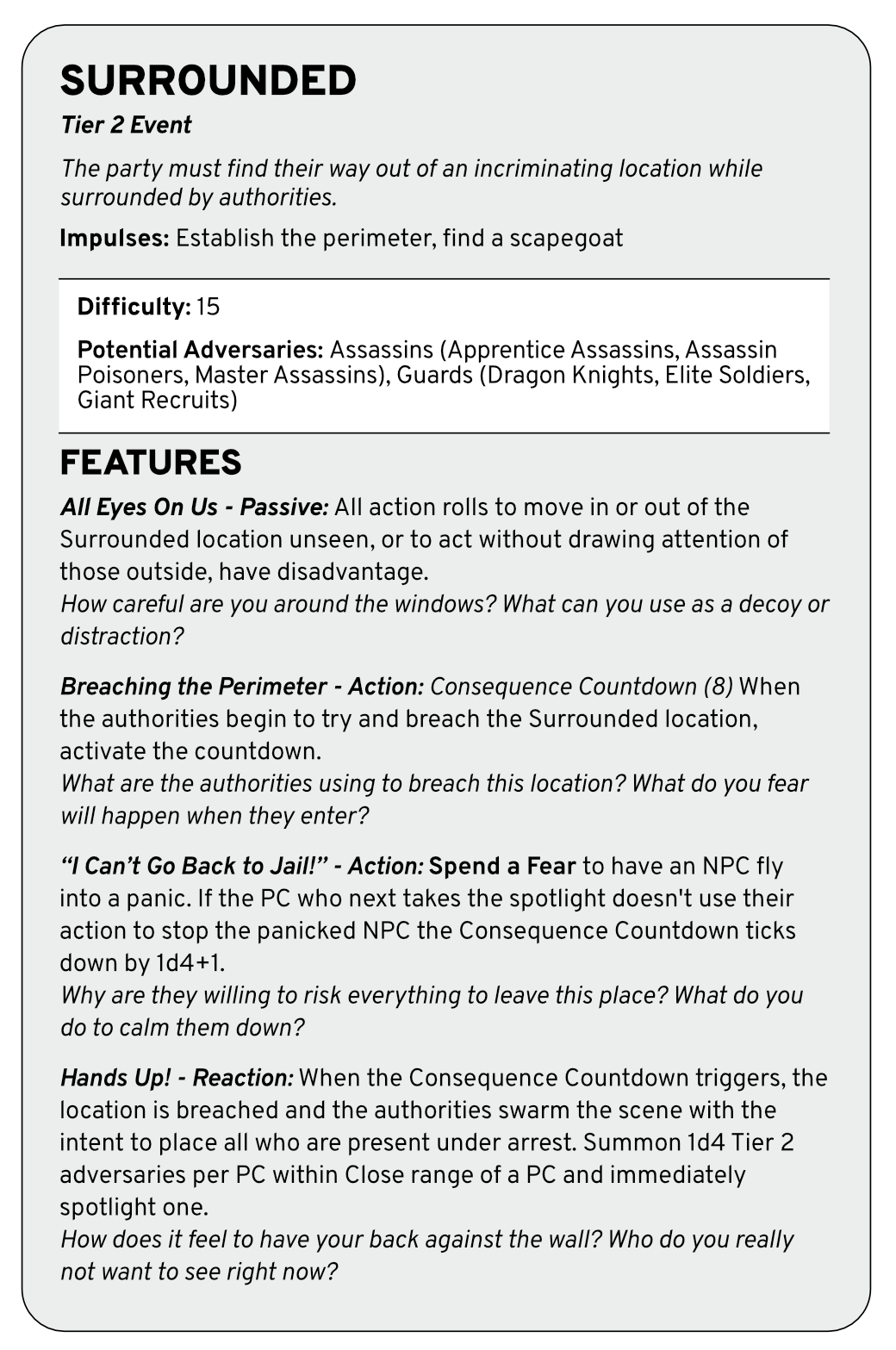
I hope you enjoyed the key takeaways from this workshop! I can't wait to see what everyone creates the more we learn about designing for Daggerheart.
Comment below on your biggest takeaway and what you want to incorporate into your next Daggerheart game.