Quarterly Questing Report - Q1 2026

Welcome to my first Quarterly Questing Report! In these posts I will breaking down all the games I played this quarter, updates on ongoing games, thoughts on new systems, and any learnings I have along the way as both a GM and a player.
Is this late? Maybe, but what are you? The Bureau of Chronological Affairs?
Let's get into it!
In Q1 of 2026 I participated in 36 total sessions, which is up from 22 sessions in Q1 in 2025.
This quarter I played:
- 24 sessions of Daggerheart
- 9 sessions as a GM
- 15 sessions as a PC
- 4 sessions of D&D 5E
- 3 sessions as a GM
- 1 session as a PC
- 2 sessions of Shadowdark
- 1 session as a GM
- 1 session as a PC
- 2 sessions of Legends in the Mist as a PC
- 1 session of Pathfinder 2E as a GM
- 1 session of Alice is Missing as the GM
- 1 session of Vagabond as a PC
- 1 session off Nimble 2E as a PC
This is also a much higher variety of systems compared to last year. In Q1 of 2025 I played 9x D&D 5E, 6x Daggerheart, 6x Alice is Missing, 1x Tales of the Valiant. I definitely want to continue this trend of trying out lots of new systems.
I am very fortunate to have had the opportunity to play in this many sessions, but I don't foresee this pace continuing for the rest of the year. Some of these were three game days, which is A Lot.
Now let's break it all down!
Pathfinder 2E
I ran the second half of the Pathfinder Beginner Box for my two player table (which typically plays 5E/DH). We played the first half just before New Years. I made modifications to the encounters to scale it to two players following this Reddit post here.
Before this I had demoed PF2E once at Gen Con in 2019 and didn't have much trouble picking it up to play at all, but I definitely struggled GMing it more than I anticipated. The PCs were just getting hammered with encounter after encounter as they moved through.
I tried having the PCs track XP, but we didn't really like how after every encounter they would immediately ask, "Okay how much XP did we get?". It interrupted the flow quite frequently. Also several of the XP amounts felt unfair for the amount of trouble they created. For example, there was a Simple Trap where stone blocks fell on to one of the PCs in a hallway and they took more damage from that then the entire kobold fight in the previous room, but only received a measly 8 XP for their troubles.
There were also many instances where I had to look up additional rules when the players tried to do things that were on their character sheet, but outside of the scope of the Beginner Box. This may just be a problem of experienced TTRPG players but brand new PF2E players clashing with a basic starter set. Halfway through the adventure it also recommends that the PCs go back out of the dungeon, rest, resupply, and come back but there's no real indication of how to do that or how to handle covering areas you've already cleared previously. For example, the PCs got XP for avoiding a giant spider, which means that even if they crossed back through that area and fought it on the return trip then there would be no XP gain to it.
We did enjoy how the adventure had spots to highlight each of the pre gen classes that came with the Beginner Box, but it did make those moments sort of barred off from the PCs that we only had two. It was fine, but something to keep an eye on.
I talked to a few GMs who run PF2E more regularly and they said that the set up of the Beginner Box sounded like way too much, and that they don't run nearly as many combats in a single session. I would like to give it another try and compare the Beginner Box to how their regular adventures are written.
Alice is Missing
I ran a session of the base game via the PixelTable digital version for a group of all new players
to the game. The digital version is excellent. Only one person needs to purchase it for the entire group to use it and it makes the game very easy to pick up and play.
At this point I have ran 30+ sessions of AiM including the Silent Falls expansion and the Whispering Pines DLC. This game intentionally leans heavily tropes to give people familiarity when they interact with the story, but the game as a surprising amount of replayability. While there are similar throughlines throughout the sessions, it has been interesting to see where they diverge in play as people bring their own ideas and experiences to it.
And as always, the Alice is Missing soundtrack is amazing.
Vagabond
One of my players brought over Vagabond to try out for my birthday. We practiced making characters and tried out a few short combats 1on1. We each made one character, and it was very easy to pick up and play. Then I ran both PCs in increasingly escalating difficulties of adversaries just to see what the PCs can handle. We also tried a little bit of the hexcrawling rules.
Playing 1on1 it definitely felt weird to play a roll under skill game and not have the GM rolling. It definitely felt like, "I roll, and I roll, and then I roll again".
I am interested to play more of this and see what the system has to offer in complete play.
Nimble 2E
I played in a one shot of Reach for the Stars from Keys from the Golden Vault that the GM converted into Nimble from 5E. The adventure was a lot of fun and ran pretty smoothly for being a conversion to a different system.
The character sheet is quite deceptive. It seems like it would be very simple because there aren't many fields to fill in, but that's because you have to basically have to handwrite all your abilities in. This also made it tricky as a brand new player to try and figure out how to truncate the abilities on the sheet while still understanding them. Character creation as a whole was very much "trust the process". There was not a lot of explanation on what you were doing, but if you just kept following along it all came together pretty smoothly. I played a level 3 Elf Oathsworn called Rook and it took longer than expected to make and level up the character.
In play it was relatively straightforward, though there were a decent amount of kickers you have to be familiar with or integrate into how you wrote it on your sheet to remind you. In that way it felt similar to Draw Steel. I played a one shot of that for that for the first time in November of last year. I don't know if I would consider combat in Nimble faster than 5E, but that could be attributed to it being a brand new game and a lot of us going "wait! I think I could do X!". The Oathsworn was a lot of fun to play as I bludgeoned my way through enemies in my aura of Judgement.
I would be down to play it again, but I think this one shot scratched my curiosity itch for Nimble.
Shadowdark
Lost Citadel of the Scarlet Minotaur
I GMed Shadowdark for the first time running Lost Citadel of the Scarlet Minotaur for two players. We were supposed to have three, but someone had to drop at the last minute. I run a lot of 5E and Daggerheart with only two players though so I decided to press forward with the game.
I had heard a tip for running these kinds of games is to pre roll some of your encounters so that way you know what's coming up in the session. So I numbered my paper 1-25 for what I hoped would be enough crawling rounds for the session, rolled random encounter checks for each of those rounds, and then rolled encounters for any rounds that got them. (I later learned that most people DO NOT mean doing it by round when they say pre rolling encounters. Whoops.) This was extremely helpful during the session though because I didn't know where they would be or what they would be doing when each round came up, but I knew what would happen when it did allowing me to add it on the fly more easily. The only downside was I wanted to embrace the true randomness of Shadowdark, but it was a bit of a drag that we didn't have an encounter for the first 13 crawling rounds.
The other tricky bit was since we only had two players it became very much a one person searches, and one person keeps watch, on essentially every turn. We were all still getting used to the idea that if they ask for something they just get the info.
Ex. I look under the statue! Since you looked you found the item that was under there.
But if they don't ask then it seems you're not supposed to tell them.
Ex. They didn't ever say they were looking up or searching the ceiling so the little guy hiding up in the corner was never mentioned.
Overall we had a good time though! Highlights of the session included the PCs figuring out how to use the charging bull traps to their advantage, and the dice gods forsaking me that the 50/50 chance for the trap to go off NEVER triggered when the PCs walked by but triggered EVERY TIME they put an enemy in front of it. I also really enjoyed the countdown to an encounter with the Scarlet Minotaur, and how properly scary the encounter with the minotaur was.
One PC died alone in the dark trying to valiantly strike at the minotaur as it went by. The other PC carrying the torch wrapped around and made his way to the exit of the dungeon, never finding the body of his fallen companion (who was carrying the majority of the treasure!)
I could see how if we were continuing to play they could regroup with a new PC to head in and retreive the body and the treasure with the threat of the minotaur still roaming the halls.
Shrine of the Jaguar Princess
Then, I played in Shrine of the Jaguar Princess. It was GMed by Arrowed and it was an amazing introduction on how the system should be run! We plowed through the entire dungeon in one massive 5.5 hour session (the longest I've ever played), but that was because we didn't want to stop!
I played Leif, the level 3 half orc Sea Wolf. At level 3 Shadowdark characters are surprisingly powerful. I had a backup character just in case, but I was cleaving through enemies with She Who Beheads in Smoke, the battleaxe I had found in the temple. It was still hazardous though! I almost got sucked into the void of space and just barely met the DC needed to prevent it!
The dungeon was super flavorful and had challenges for the players as well as the characters, which was interesting to me. Patchwork Paladin played a Basilisk Warrior that allowed her to survive a poison that would have outright killed the rest of us!
What shined the most for me was the rhythm of the procedure. I was honestly surprised that it didn't have more strict and methodical check phases, so it moved pretty speedily in play. This was helped of course by having experienced players and GM at the helm. It definitely feels better to have a full party. It keeps the energy up and allowed the spotlight to passed around to whoever's crawling turn it was without lots of deliberating between turns. This group was very decisive, despite the push and pull between the desire to push buttons and find all the goodies, and the desire to be careful, thorough, and pick your battles.
Since it was a one shot we were driving our characters like stolen cars, but I would have been interested to see how it works over longer term play. We discussed that if we had had more time we could have exited the dungeon, leveled up, geared up, and returned.
I loved this session, and would like to play more Shadowdark, especially multiple sessions, so that way I can see how the XP and carousing system works. Sersa Victory's dungeons are a treat.
Legend in the Mist
Learn to Play: The Lost Hermitage
I played the pre gen character Finn the Red Marshall in a Learn to Play session running the adventure The Lost Hermitage. I absolutely loved the tag system for characters. It was extremely helpful from a narrative standpoint and was very cool as a mechanic. It added an element of resource management I was not expecting from a more narrative game that I quite enjoyed. Being able to point at my character sheet and go Finn is an "Aspiring Local Hero" so I'm going assure the townsfolk that everything is alright, but he's also "Rash" so I'm going to dive into the water after the glowing thing at the bottom.
I picked up the PDFs just on this session alone. The art is gorgeous, the characters are flavorful, and the adjudication of the system is very creative and collaborative. I found the tags so fun that I added tags to my upcoming Daggerheart campaign character to help me think about the character as I'm RPing him.
Fox in the Dales
I enjoyed the first session so much that I played in a second one shot! This session we had the opportunity to create our own characters with Origin playbooks and one Adventure playbook.
I created a roguish character called Ryn (they/them). Going through the playbooks was super fun. There was definitely a bit of a challenge in the balance of covering a variety of skills versus having enough tags in the things you specialize in. I made my character just on the PDF character sheet but our table also spent some time fiddling with the Characters of the Mist online tool.
When it was time to play we also did one round of Daggerheart Connection Questions to link up the characters for the start of the one shot. I've been seeing more and more tables using these regardless of system to quickly connect characters. (We even used it when I tried Draw Steel for the first time!). We tried out a bit of the Fellowship creation system and we started with some improvements already on our character sheets so we could see how leveling up and resting worked in this system.
I loved these sessions and I definitely want to play more of it and take a crack at GMing it myself.
D&D 5E
Candlekeep Mysteries
One of my main tables is a two player group that alternates between playing Candlekeep Mysteries and Colossus of the Drylands in Daggerheart. We are playing Candlekeep as loosely interconnected adventures where the PCs get to level up after they complete each mystery.
Prior to this we have played The Joy of Extradimensional Spaces, Mazfroth's Mighty Digressions, Book of the Raven, Shemshime's Bedtime Rhyme, and then A Deep and Creeping Darkness. We skipped A Price of Beauty, and instead did a homebrew side quest very loosely based on The Princess and the Goblin with the princess being Gailby from Shemshime's Bedtime Rhyme and the goblins being drow trying to infiltrate Candlekeep from below.
During this quarter the PCs ran through the adventure Book of Cylinders over the course of sessions # 17-19. The PCs were level 9 and include a drow Inquisitive Rogue and a half elf Pact of the Great Old One Warlock. Sly Flourish's Lazy Encounter Benchmark is absolutely essential for balancing encounters for small groups like this, and works really well.
The main thing I changed in this adventure was reducing the number of checks required to cross the Crab Maze outside the Grippli Village. Instead of making like 10-20 Stealth checks and potentially triggering crab attacks each time (why is the map so big??), I had the PCs make three checks to cross. The crabs got them good on one of them and whittled down a little bit of their health.
At this point I also realized that group Stealth checks are a bit of a moot point now since per the rules, "If at least half the group succeeds, the whole group succeeds." and I have a rogue that can't roll below a million on Stealth. I also accidentally gave them both boots of elvenkind in the last adventure so I'm really in trouble now. (Note to self: Don't use that fun bit of lore you found in the wiki right before the session and describe in game that drow forward operating parties receive boots of elvenkind as part of their kit. The PCs will immediately knock out two drow and take their boots).
The PCs managed to save almost all the grippli eggs and either destroy or drive out the remaining evil yuan-ti from the village. The Rogue also took the Moderately Armored feat on his level up so he could wear the Serpent Scale Armor, and now has an AC of 20. Yee haw. The other thing we are also noodling with is modified short rest rules to decrease the time needed for the first short rest of the day so the party isn't punished too heavily in the narrative when the Warlock needs a short rest.
Next up is Sarah of Yellowcrest Manor! I am excited to tie this to the Warlock and show her a different Great Old One in action.
VoidSea Naval Combat Playtest
Despite having run 5E since 2016 this was only my third time getting to be a PC in 5E. A friend had backed VoidSea and was interested in seeing how they might incorporate some of the naval combat mechanics into their Aetherial Expanse campaign.
I created a level 8 Pact of the Fathomless Warlock and boy howdy is DnDBeyond a PITA to use right now. Thankfully I have decent system mastery to be able to sort out what was going on, but creating a higher level character is not intuitive and its surprisingly annoying to find your available stuff in play.
Once we got in the rhythm of the game though, things flowed pretty quickly. I liked how the ships went at the top of the initiative order, and that there was a ship action per PC because while on a ship you can't always use your regular character actions.
Daggerheart
Beast Feast
The biggest highlight of the quarter for me was finishing the Beast Feast campaign I was in. It was my first every campaign as a player, and the first ever campaign I've been a part of that saw the story to its completion. I don't think any words here can do justice to how magical this campaign was for me.
I played a Loreborne Infernis Wizard named Milo Kosmer who's goal was to fill his historical cookbook with monster recipes. We played 26 sessions over roughly 13 months and the characters went from levels 1-5. I created the party cookbook which I shared with the group for the finale as an artifact of our travels.
In the campaign finale the PCs (known as the Lure-kers) finally reached the bottom of the Plover Caves to find and hopefully restore the Lure. We fought Etrigal, a colossus dragon who breathed black soul rending fire, rescued the archmage Hylaeus from inside the Lure where they were stuck in constant battle with Abaddon the King of Demons, released Abaddon, and ultimately defeated him! With six players, one guest player playing Hylaeus, tons of demons, environmental stat blocks, and countdowns it was a suitably epic fight for a final battle.
At the end of it all, with the demon king defeated, the Lure was failing. The life force of Hylaeus and our Clank Seraph who was made by their hand was flickering, and our GM gave us a choice. The Lure needed a soul inside it to draw the monsters down to it so to repair the Lure and restore balance to the Plover Caves someone would need to sacrifice themselves inside. Hyaleus, the Clank Seraph, and I argued about who would make the call until our other seraph stepped in. Daughter of a Faint Divinity of Death, and the graveyard keeper back in the village of Elmore, she asked us, "It's easy to die for a cause, why not live for one?"
The group decided to seal the Lure without anyone inside to save our friends, and pledged that we would help the people of the Plover Caves learn to live with their new monstrous ecosystem and perhaps prepare the monsters they slayed for delicious meals.
Our GM and my fellow players did such an amazing job, I'll never forget this game.
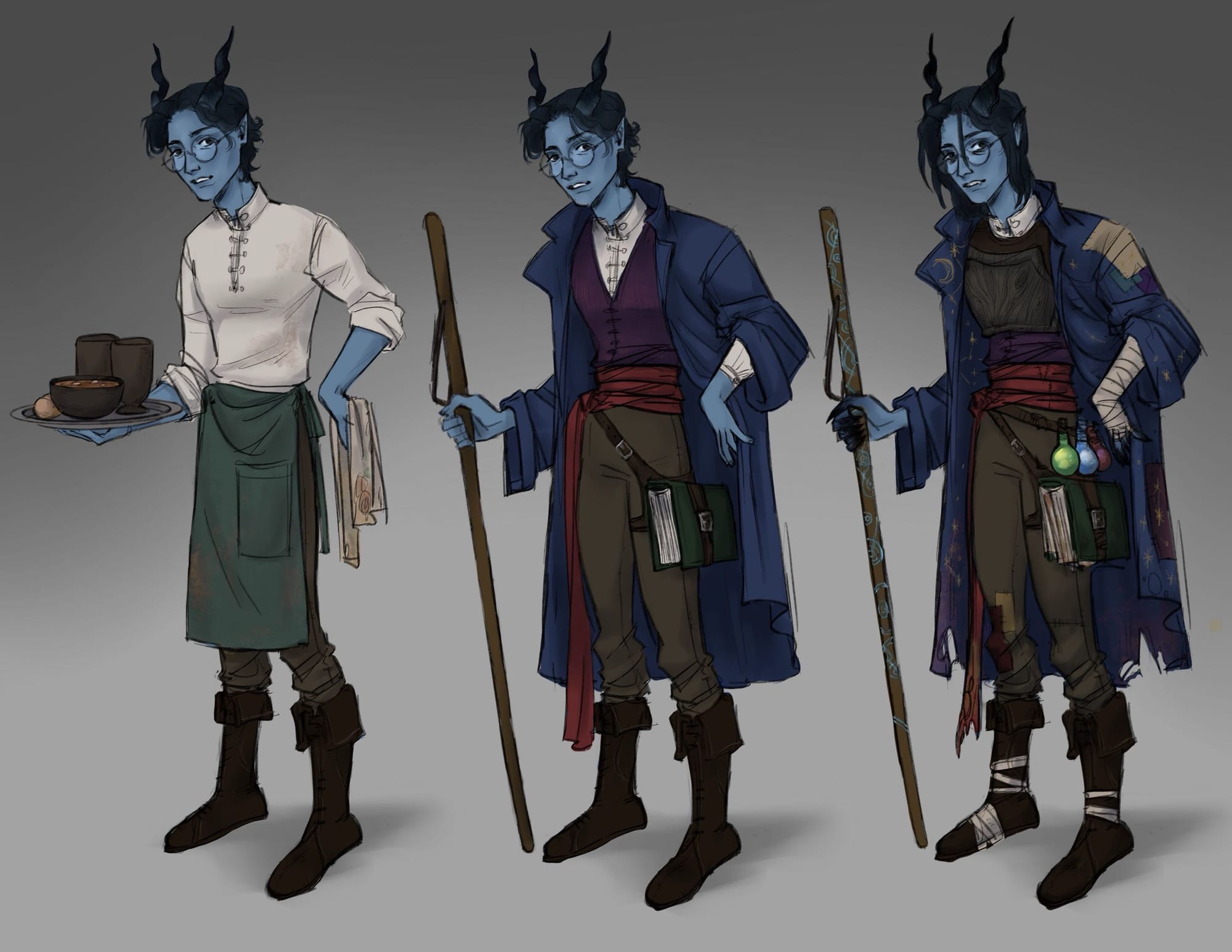
Motherboard
After our Beast Feast campaign concluded we started a new Motherboard campaign it's place. Four of the six players from the Beast Feast game returned to the table run by the same GM. And two new players joined us!
We've only had our session zero and first session so far, but I am really looking forward to this story. Initially Motherboard was one of the frames I was least excited about, but now that the story is taking shape I am pumped.
For this campaign I am making a big pivot from my wizard and playing "Lucky" Fray, a Wildborne Giant Guardian from the tree overrun skyscraper of Calcarus. My entire character concept is about being lucky and near death experiences, so I made my first ever mixed ancestry character and added the Halfling "Luckbringer" trait. My Guardian is also absolutely terrified of heights, which I'm sure will have no repercussions at all.
Colossus of the Drylands
This is my two player table that rotates between this and Candlekeep Mysteries. In this game we have a Highborne Katari Wayfinder Ranger who has gotten into big game hunting as part of her eat, pray, love journey after her divorce and a Ridgeborne Giant Call of the Slayer Warrior who has been hired by the Ranger to be her muscle and her guide for big game hunting.
During this quarter we played sessions # 6-9. The PCs were taken back to Wylin's Gulch by a bounty hunter after some of Mr. Destry's thugs attempted to attack them on a dinner train. The PCs met with Mr. Destry and boy howdy do my player's hate this smug mining baron with the fire of a thousand suns. The Warrior seriously contemplated lighting the dynamite in his bag and taking the entire fancy brunch place with him just to get Mr. Destry to stop talking.
The PCs also defeated their second colossus, Balorma the Blooming Hornwolf. When we start up again the PCs will be level 3. I am really liking this campaign for it's structured phases and clear markers for leveling up.
Sablewood Messengers + Protectors of the Wyrmhearth
I introduced a new table of four players to Daggerheart using the free quickstart adventure The Sablewood Messengers as a trial before we started a full campaign. The players loved it, coming from a primarily 5E and Pathfinder background. (Though I have run a little Brindlewood Bay with this group and they also enjoyed that). They especially loved the attack on the cart, and the final battle during the ritual.
I had some discussions with other GMs on style and length. This is my third time running this adventure and I find I have to really stretch it to cross the 2.5 hour mark in run time. On the flip side I've heard of other GMs barely finishing it in 4 hours. The consensus seems to be attributing it to how much time the PCs spend in the village of Hush and RPing with the Whitefire Arcanist. But more testing to come on that.
After that intro the players created their own characters, and then we played sessions # 0-2 in a new campaign frame I am writing and testing called Protectors of the Wyrmhearth. We have an Orderborne Clank Warrior, a Highborne Human Wizard, an Underborne Galapa Ranger, and a Reborne Reanimated Faerie (technically Fungril) Druid.
It's been a lot of fun! The key pieces of feedback I've received from the players has been:
- The collaborative worldbuilding prompts allow everyone to scratch that authorship itch as a player, especially for those who are typically the GM
- The players like the story being a little slow at the beginning of the campaign. It's been giving them time to acclimate with the world and explore their character
That last point surprised because I was over here worried about giving them a single day of downtime in session 2, but I'm happy that I'm not driving the campaign with such an insane amount of urgency to the point that the players can't engage with the world I have made.
This campaign has also been a great motivator to continue writing progress on this project since I need to prep for the sessions anyways!
Drakkenheart: In Search of the Smuggler’s Secrets
I GMed about half of the standalone Drakkenheim adventure, In Search of a Smugglers Secrets converted from 5E to Daggerheart! I wanted to take the beta campaign frame for a spin and have also been interested in trying to convert a 5E adventure to DH.
The conceit of the adventure is basically going into the sewers and clearing out three separate areas on behalf of a couple different factions. All in all a fun adventure with a good mix of combat and alternative solutions to situations! It's a level 3 5E adventure and I had the DH characters be level 2 just to give them a few extra toys to play with. While I typically GM Theater of the Mind, I did use Owlbear Rodeo for maps and tokens because the adventure came with all the maps and it was handy to help visualize what was going on.
A highlight of the session was the party being split across some tunnels and the Sorcerer and the Rogue getting munched by an otyugh (a reskinned acid burrower). As well as at the very end of the session the Rogue Shadowstepped into a room and then sneak attacked a guy, killing him in one hit, only to turn around and see the room absolutely full of merrow folk.
In regards to the actual conversion from 5E to DH:
Pros:
- I kept all the checks and DCs basically the same across the board
- Adding the Hope or Fear factors to each roll added some interesting wrinkles to what would otherwise be pass/fail checks
- I loved throwing the spotlight around to resolve people's intents
- I loved adding Daggerheart collaborative worldbuilding questions on top of an already existing structure to give it some additional flavor and tie the adventure to the characters
- Because of the ongoing nature of the crawl I didn't feel like you had to really balance for battle points. You can have just one Solo because they're likely gonna fight more stuff later
- I was worried I was going to have to make a lot of custom monsters, but really between the DH core book, the Void content, and a little Incredible Creatures I was able to find something close enough for everything I needed with minimal reflavoring or adjusting
Cons:
- You have to really closely read your adventure. And I mean really closely. I probably read the adventure through like four times because each pass I was noticing more adversaries, traps, puzzles, and magic items that I wanted to make sure I had wrapped my head around and made Daggerheart.
- You have to consider what environmental/trap consequences translate to in DH. In 5E 2d4 necrotic damage from falling into contaminated water in not really a big deal, but 2d4 damage in DH is much more punishing. Also things like having a pipe burst and spray contaminated water on initiative count 20 each round also does not apply in DH
- You have to convert all the monsters. Not only their stat blocks, but also thinking through their types. Now this adventure does include some of that "unbalanced combat" where you're presented with a situation and if you can be smart about it you talk, or tactically fight your way through (it is a 5E adventure after all). But instead of just having a dozen merrow I decided what the mix of standards, minions, bruisers, would be based on how it was set up in the adventure.
All in all it took a decent bit longer than I normally spend prepping to do all the conversion, but we only used about half of what I worked through. So if we played the rest of the adventure I'd have to do minimal prep. I could see myself collecting a toolbox of conversions to use for future 5E adventures, and have some of that thought process already worked out.
I am very excited for the complete Drakkenheart book to come out and see what's in store for us!
Age of Umbra
In this game I play Simon, a Warborne Human Order of the Ghostslayer Blood Hunter. During this quarter we finished our first major arc of the campaign. After completing the Inciting Incident, rescuing the hunters from the Shulk Chasm, and defeating the corrupted celestial inside, our party worked on defeating the Cult of the Scarlet King that was taking root in Okros.
What's been really important to me in this campaign is the focus on how there's always hope in the darkness. The people in the Age of Umbra are called The Enduring for a reason. In the end we were ultimately able to have mercy on the cult leader, and grant him closure from the grief that was driving him to give anything in hopes of driving back the Umbra.
The party now sets out to kill the corrupted angel that created my PC's backstory trauma, before setting out across the map for further adventures. What I love about Daggerheart's session zero process is that just by each player adding a location or two to the map, and some things they are interested in, we have so much potential story ahead of us that will keep us busy for quite some time.
One Shots
I played a Clank Wayfinder Ranger in a one shot helping playtest Patchwork Paladin's hexcrawling rules for Daggerheart..
I also played in a one shot for StartPlaying's charity event to support the Immigrant Rapid Response Fund via the Women's Foundation of Minnesota GMed by the lovely Kai Solace (who was a fellow player in my Beast Feast campaign)
I also played a level 4 Ridgeborne Katari Bard in a Motherboard one shot as preparation for our upcoming Motherboard campaign that allowed me to complete my quest of playing all the Daggerheart core classes.
Key Takeaways
- I love trying new games! Especially under experienced GMs. It just really makes the experience so much more enjoyable.
- I am eternally grateful for my Beast Feast campaign breaking me of the "forever GM" moniker and opening me up to the player side of things
- Daggerheart is really stealing the show for me and I'm excited to catch up my number of GMed sessions to my number of played sessions. It's also been really fun to see which parts of Daggerheart I, and other GMs, can steal and put into our other games.
What kinds of games did you play in the first part of 2026? What are you looking forward to playing this year? Let me know!